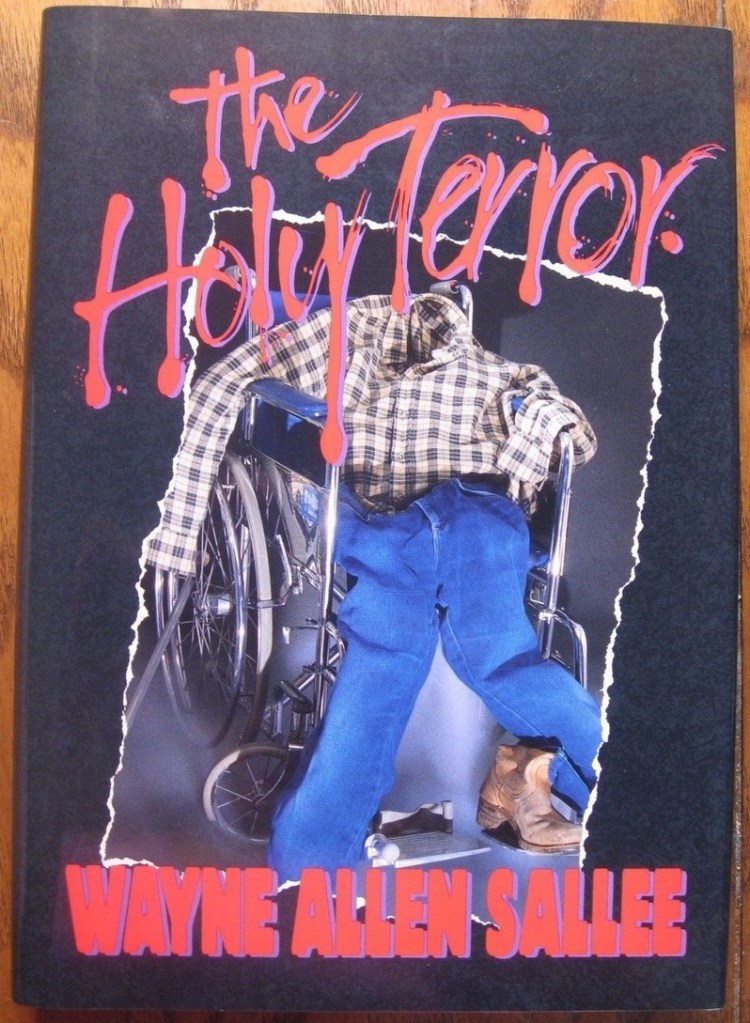
A serial killer is roaming around Chicago murdering people in wheelchairs by absorbing them into his chest. A person with a mental disability and his self mutilating friend decide to put a stop to this.
I wanted to like this book, but it didn’t really work for me. The supernatural element of the story, the method of killing, is bizarre and unnecessary. It’s quite confusing and doesn’t add anything to the suspense of the story. The plot would have been easier to follow if the murderer was using a dirty needle or something to kill his victims.
The biggest problem here is that here’s far too many characters. It only becomes clear in the last 3rd of the book who the main characters are. Up until that point the reader is seeing new names every few pages and struggling to figure out which ones are important to remember.
This is one of those books that includes lyrics from songs. I hate when authors do that. Stephen King and Shaun Hutson do it too. It’s lame. We get it. You like music. The problem is that your taste in music sucks. Keep it to yourselves, dorks. The author also gets too literary for his own good. This book features a prostitute with 2 heads. This is not the place for stream of consciousness and diary entries. You’re not James Joyce bro.
I read a short story by Wayne Allen Sallee in the Splatterpunks collection years ago. I can’t remember it specifically, but reading this book definitely reminded me of the stuff in those collections. There’s a kind of edgy self awareness to the writing that feels a bit contrived. At the same time, while most of the writing in the Splatterpunk collections focuses on punching down, this book does not stoop to those depths in its depictions of disabled people. I mean, they do get murdered, but they’re not disparaged or belittled. I wouldn’t say this is a particular tasteful novel, but at least it’s not completely morally repugnant.
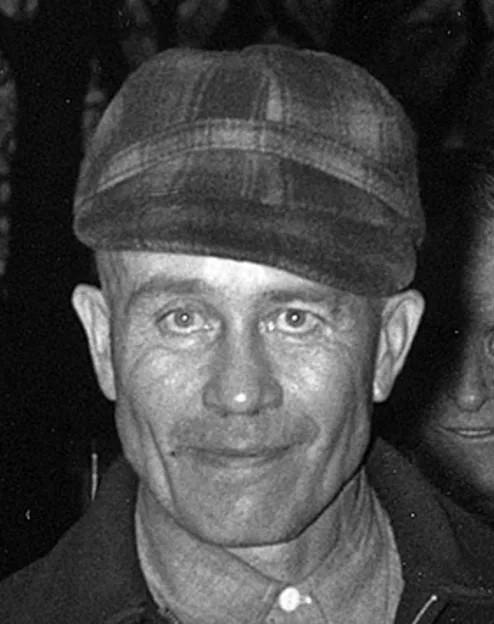
Ed Gein always seemed like the least offensive “serial killer” to me. He only killed 2 people for sure, and while these murders were horrible, what old Eddie did to the corpses was so absolutely repulsive that it makes me feel quite sorry for him. I know that’s a weird way to look at things, but the man dug up women’s graves and took the rotting corpses home. Then he cut off their skin and used it to patch together a lady suit that he would wear around his house. These weren’t spur of the moment, impulsive acts. This dude spent a huge amount of time playing with festering corpses and amputated body parts. This was his hobby. What was going through this man’s head as he greased his collection of amputated vaginas to keep them supple? He claimed that he never had sex with the corpses; he just liked chopping them into little bits and pretending they were part of his own body. I find it hard not to feel sorry for a man as completely unhinged as Eddie Gein.
I guess Eddie just seems more fucked up than evil. The stuff he did was so disgusting that I find it really hard to imagine him taking pleasure in it. There was something very wrong going on in his brain.
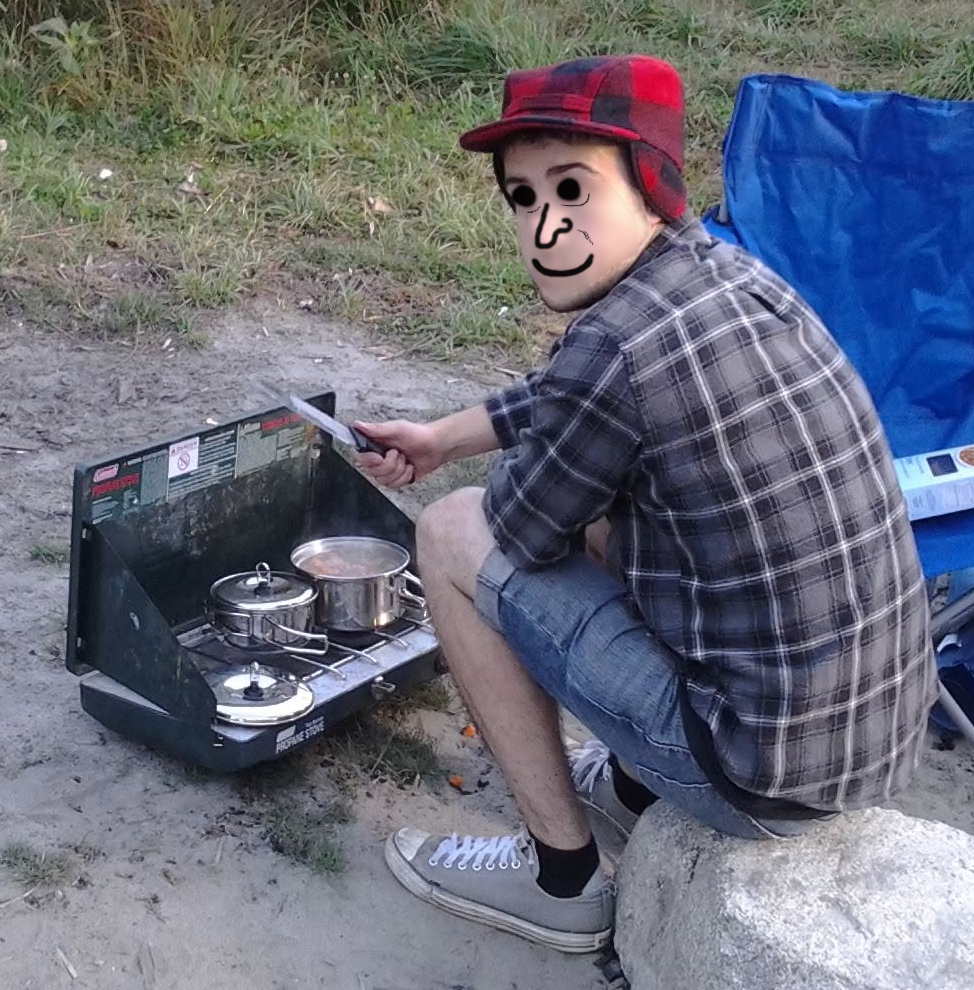
I’ve known about Ed Gein for as long as I can remember. I grew up listening to Slayer and Blind Melon songs about him, and I watched a movie about him when I was a teenager that featured a dance scene that stuck in my head. When I was 21, my girlfriend dumped me, and to make myself feel better, I spent an inordinate amount of money on an Ed Gein style hunting cap. I used to wear it when I went camping. I suppose my familiarity with him also relates to the impact that his story had on modern horror. Norman Bates from Psycho, Leatherface from Texas Chainsaw Massacre and Buffalo Bill from Silence of the Lambs are all based partly on Gein.
My Ed Gein hat
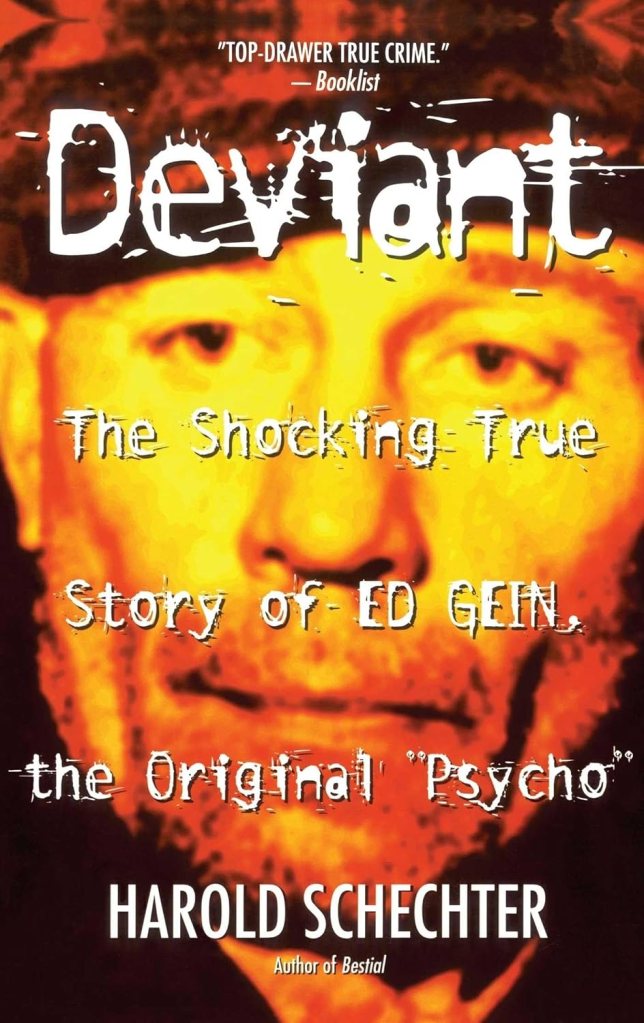
Harold Schecter’s book on Gein was decent. It felt a bit sensational at times, but the events it’s describing are so fucking gross that it was probably hard to avoid that. A lot of the stuff about Gein’s family life seemed hard to swallow, but I’m sure that has something to do with how it was so similar to Psycho. It is actually hard to believe in somebody being this messed up. There’s a lot of detail included here, and parts felt repetitive and boring, but it’s also nice to read an exhaustive account that covers every imaginable aspect of the case.
There was one part of the book that made me laugh heartily. It’s a passage explaining how psychologists asked Ed to explain the meanings behind common idioms, kind of like a linguistic Rorschach test. His responses to most of the phrases are the kind of interpretations that you’d expect from a stupid person, but one was absolutely incredible. When asked to explain his understanding of the phrase, “a bird in the hand is worth 2 in the bush”, Ed’s response was, “If you have a bird in your hand, you might squeeze him too much and kill him.” This reminded me of the scene in Of Mice and Men when Lenny crushes the mouse in his pocket.
Deviant seems to be considered the definitive book on Ed Gein. It’s not particularly eloquent, but it did the job for me. Give it a read if you’re interested in this kind of thing.
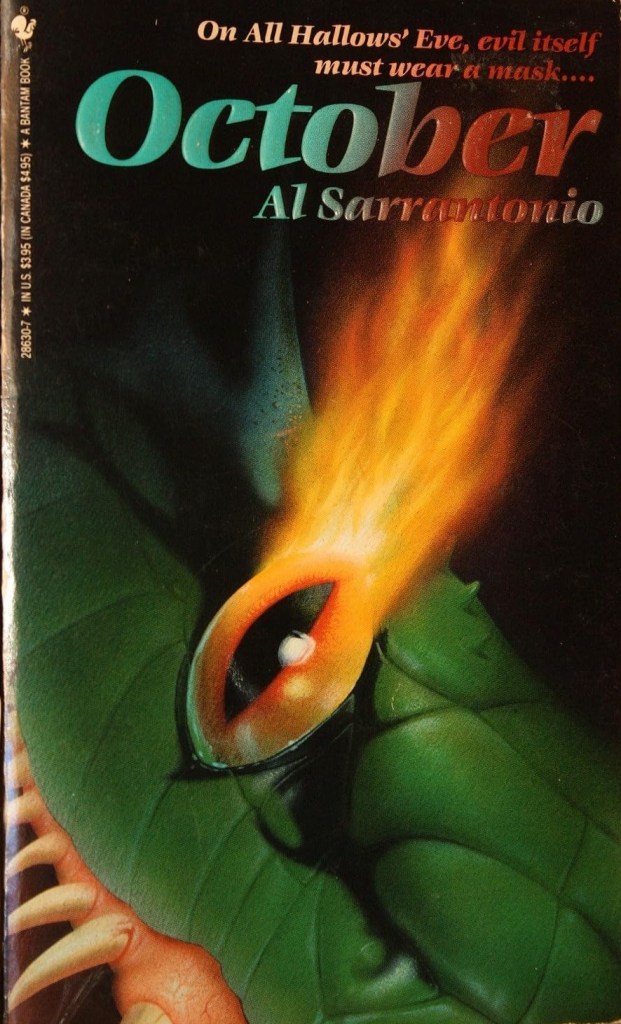
It’s been a while since I read something by Sarrantonio, and I thought this title would be suitable for this week.
Bantam – 1990
The first few chapters of this book were a little off putting. They’re about 4 different people who seemingly have no relationship to each other. A famous actor has run away from Hollywood and is hitchhiking across America. A troubled teenager is in trouble with the police. A local professor’s teaching position is at risk, and an old woman is sitting around having a think. To make things more confusing, she has Alzheimer’s and her narrative jumps back and forth. This element reminded me of reading Faulkner back in college. Things take a while to get going, but everything does manage to come together in the end.
It was Sarrantonio’s short stories that made me realize how much he was influenced by Ray Bradbury, and the Bradbury influence is strong here. I also read a review of this book that points out the clear influence of Stephen King’s It, itself a homage to Bradbury. By the end I could definitely see the similarity.
In truth though, this book wasn’t great. My favourite Sarrantonio stuff is his short stories and shorter novels. October wasn’t terrible, but I think it tried a little too hard to be literary and fell a bit short on the thrills. It wasn’t awful or anything, just nothing special. This is the second of Sarrantonio’s October/Halloween books I have read. Maybe next year, I’ll do his Orangefield series.
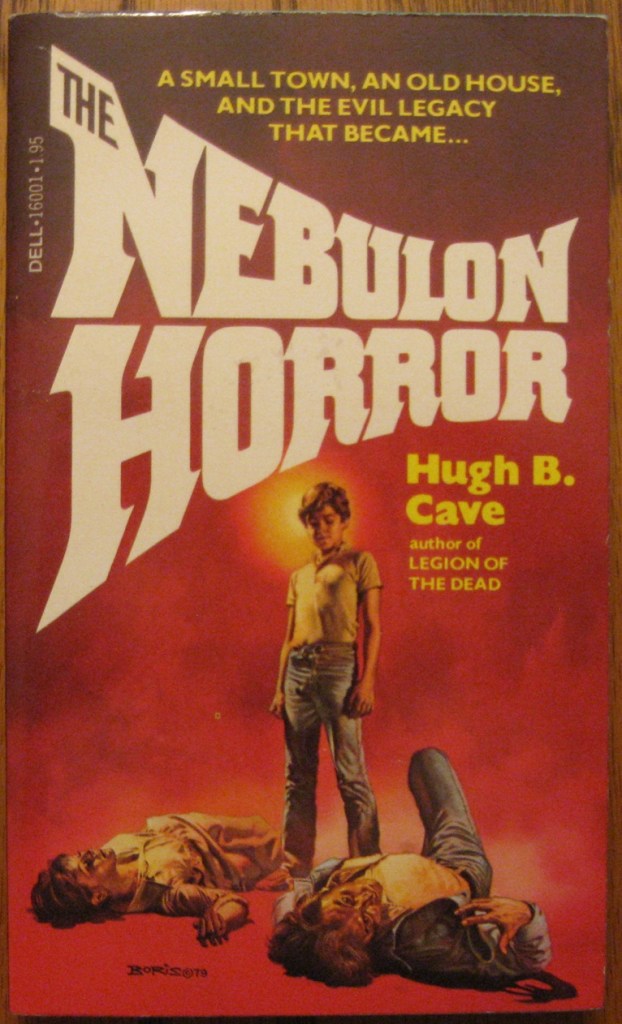
Some kids in the town of Nebulon start acting up. One of them accuses her mom’s boyfriend of trying to finger her, another tortures a frog to death, and yet another drowns a baby. Their parents aren’t sure what’s going on, but they think it might have something to do with the creepy old woman who the kids hang out with after school.
This book was basically exactly what I expected it to be. It was a bit like dinner before doing the weekly shopping. It filled my hole, but it wasn’t super delicious. I didn’t really love it, but neither did I have a bad time reading it. It was fine. It’s most memorable feature was how mediocre it is. I’ll forget about it in a few weeks. I am in no rush to read anything else by Hugh B. Cave, but I probably will at some point if it’s convenient.
I really don’t have much more to say about this one.
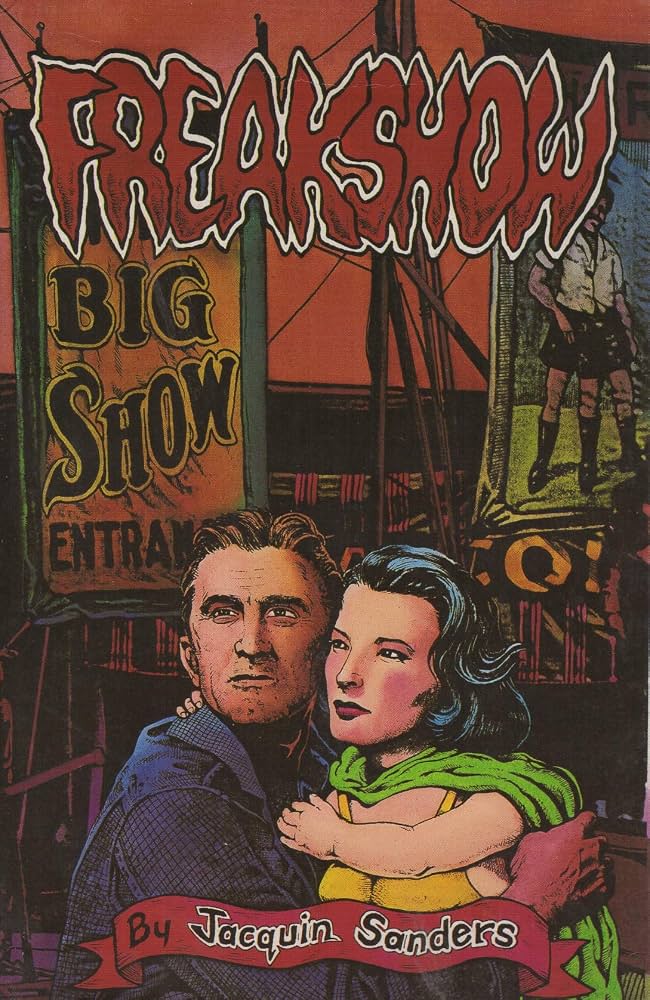
I’ve read a few books about freak shows. I loved Nightmare Alley, and I seem to recall a Tom Piccirilli novel featuring a geek. I read Katherine Dunn’s Geek Love a few years ago but decided against reviewing it here despite really enjoying it. I quite like freaks. I feel a cetain kinship with them. I was on holidays during the summer and read a book called Freakshow that came out on Loompanics. I had no idea what it would be like, but Loompanics was an alternative publisher that used to put out books on drugs and conspiracy theories, so I had high hopes.
Freakshow – Jacquin Sanders
Loompanics – 1995 (first published 1954)
Freakshow was originally published in 1954, and it used to be titled Strip the Heart. I thought it was pretty good. It’s about Bat Fidler, a cranky, violent asshole who gets a job as a carnival wrestler. He sparks up a relationship with a stripper, but ends up falling in love with a woman with no arms who is exhibited in the Freakshow as “Fishgirl”. He ends up murdering a lad. There’s a mentally challenged lad in the carnival called Egghead who likes having eggs thrown at his face. The whole thing is rather grim, and I think it qualifies as noir. (I’m still a little unsure of the boundaries of that genre.) Either way, this was an enjoyable holiday read that got me thinking of what life was like for carnival freaks. I decided to seek out a nonfiction book on this topic.
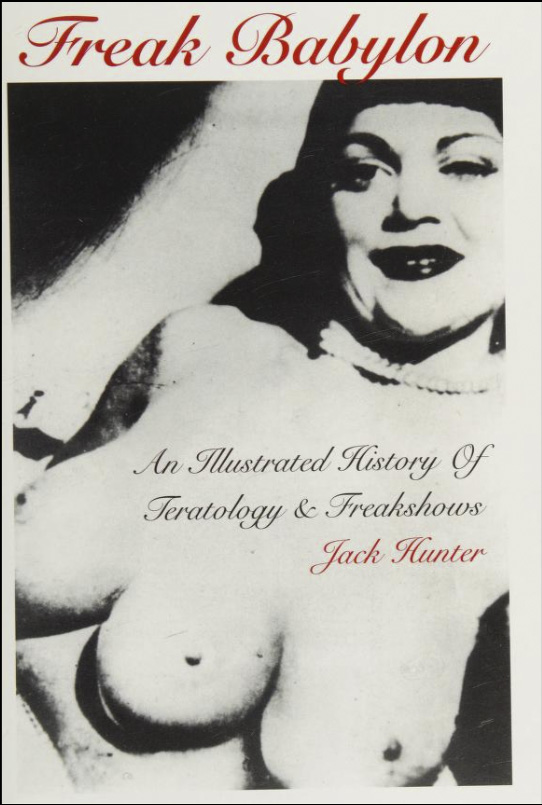
Freak Babylon – Jack Hunter
The Glitterbooks of London – 2005
I didn’t spend much time figuring out the best book on freaks to read. I just went with the first book I could get my hands on. It was Jack Hunter’s Freak Babylon.
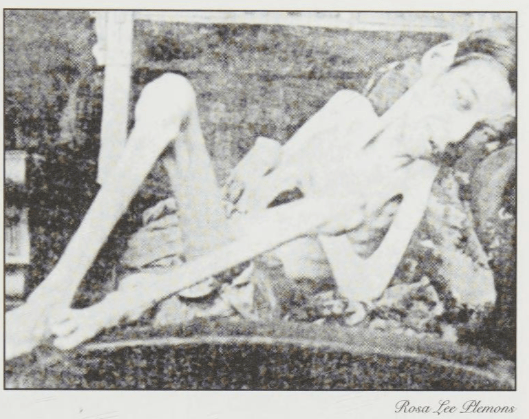
The first section confused me by listing the Necronomicon as a source, but I looked up other books referenced here, and they were all real. Much of the book is taken up describing freaks from history. Unsurprisingly, most of these people lived very sad lives, and many of them were horribly exploited. There’s not a huge amount of detail for many of these characters, and at times it feels like the author is struggling to fill pages. There is a section describing the atrocities performed on deformed or disabled people by Joseph Mengele in Auschwitz. There’s another on thalidomide babies. I was repulsed reading these sections, but in fairness to the author, I think his point in bringing these topics up was to highlight the hardships faced by anyone born different. Still, I would have prepared more of a focus on carnival freaks.
There’s lots of pictures in here, including some shots of people with deformed genitals. You probably like that kind of thing.
There’s 2 large appendices here, one describing the life of the Elephant Man and the other discussing Tod Browning’s Freaks. Both felt like filler. I went back and watched Freaks for the first time in ages. It’s a classic.
Honestly, this was a depressing read. Human beings are truly despicable creatures. We’re mere decades away from locking up and displaying mentally handicapped children for fun. As a species, we’re utterly compassionless, and our capacity to exploit others is limitless. The sooner we’re gone, the better. I don’t know why I didn’t expect this book to make me feel this way.
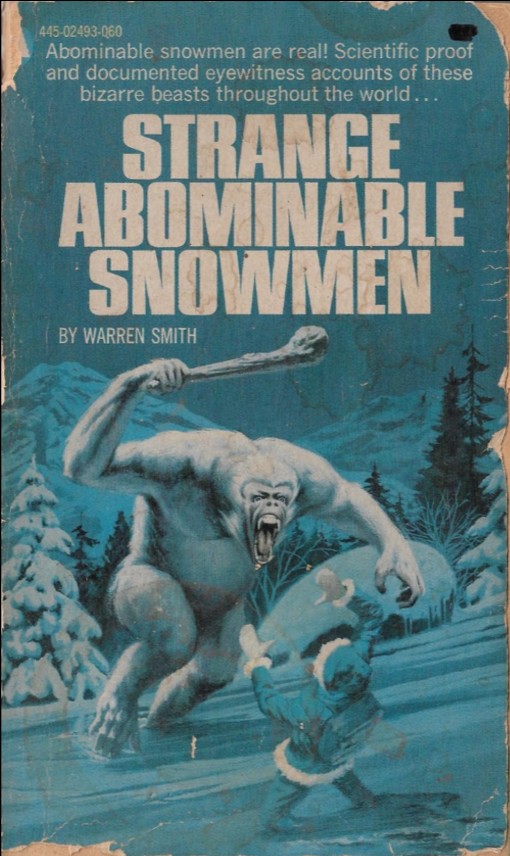
I started this book a few months ago because the cover is so sick. That thing is going to absolutely crush that mitten-wearing dork.
In the absence of new evidence, I don’t think I’m going to bother with any more “straight” Bigfoot books. I’ve expressed my desire to believe in Bigfoot a few times, but at this point, I don’t think it’s very likely that the Sasquatch exists in the same way as other animals. As bizarre as it seems, I reckon it’s more likely that he’s a transdimensional fiend or friendly psychic being than a distant and elusive relative of ours.
I didn’t really have any expectations for this book. If a text from 1970 had included convincing evidence for the existence of Sasquatch, I assume I would have read it already. Unfortunately, it seems like such a book doesn’t exist. Strange Abominable Snowmen is just a collection of international sightings of hairy beasts, many of which I had read about before, and the unfamiliar ones were very typical accounts.
“A farmer was out planting some seeds when he noticed a foul smell. At first he thought he had stepped in something brown, but when he turned around, he saw a big hairy gorilla man. It had long arms and no neck, but it ran away after the farmer screamed like a little girl. It left huge footprints for half a mile, but these were washed away when it rained later that night.”
I truly hope that Bigfoot exists and that we meet him soon.
When I was 11 years old, I went to my best friend’s house to play the first Resident Evil game on his playstation. I remember being blown away by the cut scene for the first zombie. The violence in this game was like nothing we had seen before. Unfortunately, the game was actually quite hard, so I never got past the first few zombies. It was only about a year and a half ago that I bought a pair of USB game controllers and went back and played the game through. It’s pretty clunky, but still enjoyable. Last spring, I went through all of the main games in the series up to and including Resident Evil 4. I really enjoyed the games, and I thought about doing a post on them here, but I don’t really want to get too much into video games. I was pretty happy to find out that novelizations had been written for the first 5 games of the series.
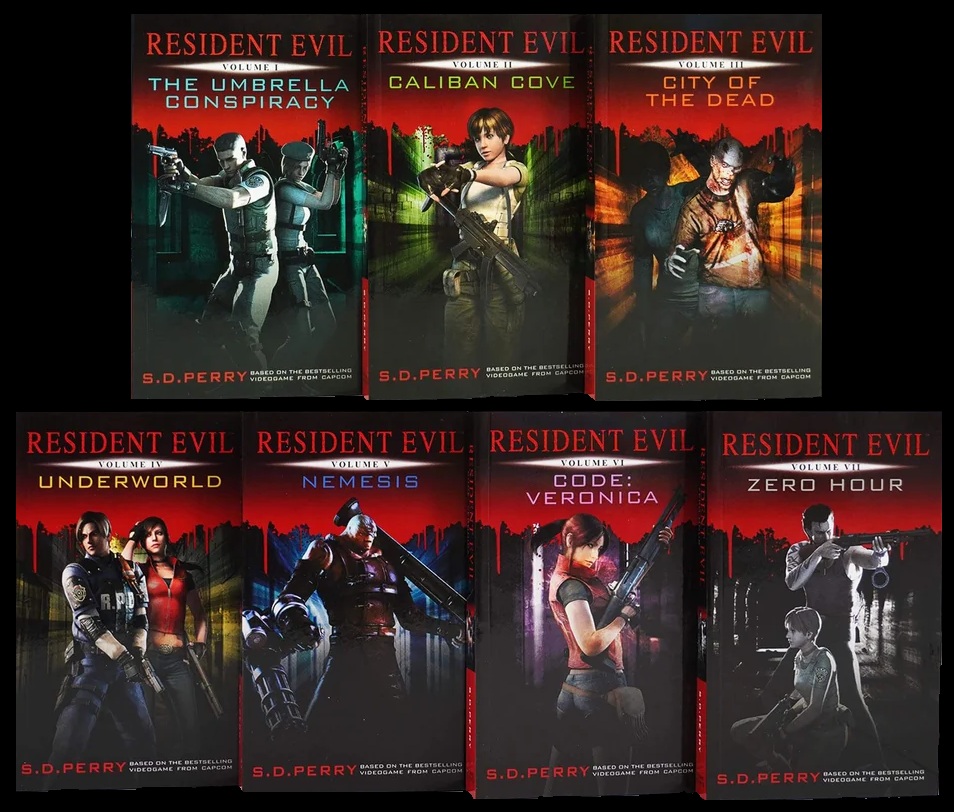
Titan Books Editions – 2012
Resident Evil: The Umbrella Conspiracy – 1998
So the S.T.A.R.S. Alpha team, a group of soldiers disappear in the woods. A second team, the Bravos, including Chris Redfield and Jill Valentine, are sent in to rescue the Alphas, but they find a mansion full of zombies and monsters. Chris manages to find one of the Alpha team, a girl named Rebecca Chambers. They figure out that a local pharmaceutical company has been performing atrocities in the name of science. The Bravos’ team leader, a lad named Wesker, is a slippery individual who seems to know more than he should. Things go horribly wrong, and a lot of blood is spilled.
Resident Evil: Caliban Cove – 1998
After escaping from the mansion, the remaining S.T.A.R.S. return to the city to find that Umbrella has convinced the public that the S.T.A.R.S. are dangerous criminals who caused a massacre. The S.T.A.R.S. vow to take revenge and head to one of Umbrella’s secret facilities in Caliban Cove. Unfortunately for everyone, this facility is run by a mad scientist with a plan to turn the entire human race into zombies. Rebecca Chambers is the main character here even though she only played a minor role in the first book. Caliban Cove is an original story. It was ok.
Resident Evil: City of the Dead – 1999
Resident Evil 2 is my favourite game in the series. The music in the main hall of the police station is my favourite. In this one Leon Kennedy, a rookie cop, shows up for his first day of work at Raccoon City Police Station. On his way he is attacked by zombies and meets Claire Redfield. Claire is the sister of Chris Redfield from the first book/game. Nearly everyone in the city has turned into a zombie, and Claire and Leon need to find a way out.
Resident Evil: Underworld – 1999
This is another original story. Leon Kennedy, Claire Redfield, Rebecca Chambers and some of the non-game S.T.A.R.S. from the Caliban Cove book break into another secret Umbrella facility. This facility has another mad scientist and a bunch of new monsters living in weird habitats. There’s also a dinosaur. The S.T.A.R.S. have to defeat each of the monsters. This one kind of felt like reading about a minigame that doesn’t actually exist.
Resident Evil: Nemesis – 2000
This is actually set a few days before the events in City of the Dead. Jill Valentine is back in Raccoon City. The streets are filled with zombies, and there is a giant monster stalking her to try to kill her. Resident Evil 3 was a bit of a disappointing game for me. The game play style was too similar to the previous 2 games, and while I did enjoy it, it didn’t feel as groundbreaking as other games in the series. The novel version was also a bit underwhelming.
Resident Evil: CODE Veronica – 2001
Claire Redfield still hasn’t managed to find her brother Chris, but has been kidnapped and imprisoned on a secret island. She breaks out, but this island is owned by Umbrella, so there is obviously an outbreak of their zombie virus, and everyone gets all messed up. There’s also a creepy mansion, and the “couple” who own the mansion are actually a creepy brother and sister. Chris shows up at the end, but so does Wesker. I really quite enjoyed the game of this one, but the novel was forgettable.
Resident Evil: Zero Hour – 2004
This is actually a prequel to the entire series. It tells how Rebecca Chambers ended up at the mansion in the first book/game. She was chasing down a handsome convict that turned out to be good, and the pair of them had to fight off a gross slug man.
The novels follow the games pretty closely, and while I was moderately entertained and comforted listening to the audiobook versions while doing household chores, I can’t imagine these having any appeal for people who didn’t enjoy the games. They don’t really add much to the story. There’s a mysterious character named Trent that shows up a couple of times, but despite the author’s best efforts, he never has much of an impact. Honestly, if you liked the games, these books are mindless fun, but otherwise steer clear.
There’s a new Resident Evil movie coming out next week. I went back and watched the 2002 movie a few months ago, and while I was decently amused, I didn’t bother with the sequels. The trailer for the new movie looks pretty good to me. I know there is some controversy over the fact that it isn’t a straight adaptation of the games, but I really don’t think that would work. I really liked the director’s other horror movies, so I am hoping to go see this new one in the cinema.
Things have been a bit choppy over the summer, but life has settled down again, so weekly posts have resumed. Next week’s post will be about some freaks.
I’m back. Sorry for the lack of posts recently. I was on holiday and dropped my phone into a pool, so I wasn’t able to log in to anything for a few weeks, and I’ve had pretty bad jet lag since I got back. The good news is I never stopped reading and have plenty to post about in the coming weeks.
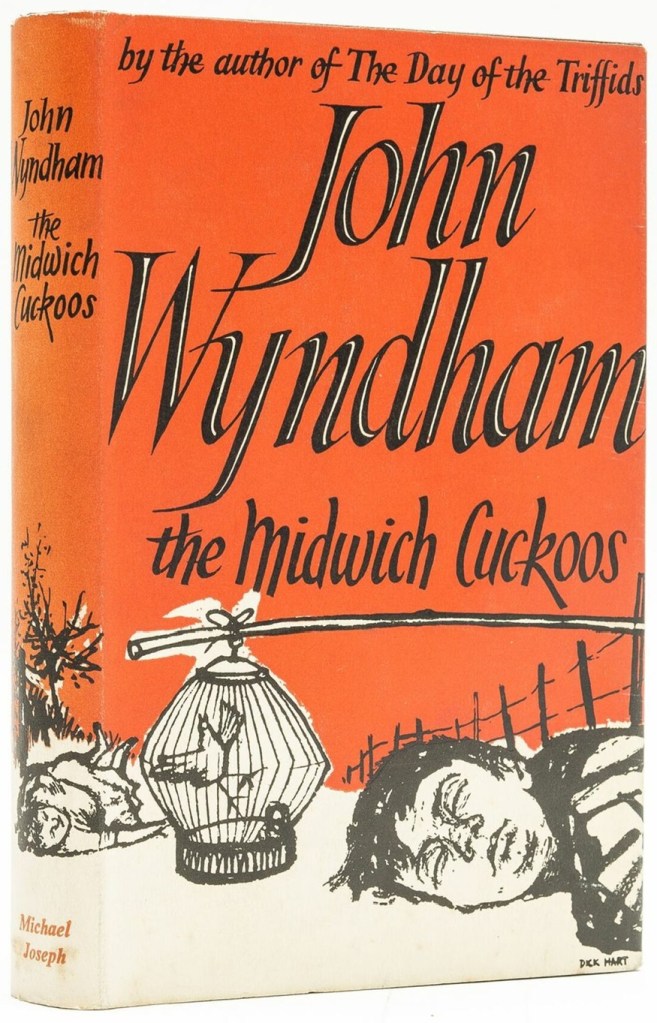
The Midwich Cuckoos
Michael Joseph – 1957
Thanks to The Simpsons, I’ve had a rough idea of the plot of Village of the Damned since I was a kid. I only recently realised it was based on a book, and I remembered enjoying Day of the Triffids and The Chrysalids by Wyndham when I read them years ago, so I gave The Midwich Cuckoos a go.
This one starts off with an entire village being mysteriously knocked unconcious. 9 months after this, all of the women in the village give birth to weird children that all look and act the same. It turns out they’re psychic aliens or mutants or something, and they’re up to no good.
This one was more creepy than scary, but I quite enjoyed it.
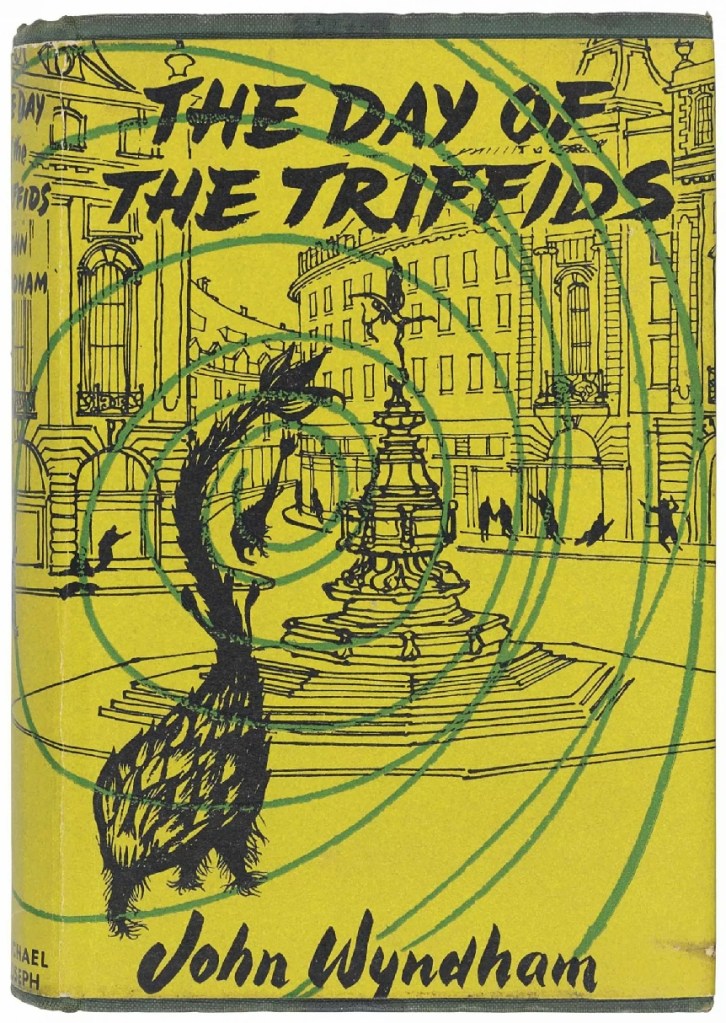
The Day of the Triffids
Michael Joseph – 1951
I reread after finishing The Midwich Cuckoos because I knew I wouldn’t have much to say about that book alone. I genuinely did not remember how miserable this book gets. It’s awesome.
A dude wakes up after an eye operation and discovers that almost everybody else had been blinded. This scene reminded me of the opening of 28 Days Later. It turns out that movie was very much inspired by this book. So a few of the people who are able to see start trying to restart civilisation, and everything goes to Hell pretty quickly. I really liked this element of the book. The inherent selfishness of human nature is definitely the biggest threat to these characters. There’s also some sentient carnivorous plants with legs. This is an extremely enjoyable post-apocalyptic novel that blurs the lines between science fiction and horror. It reminded me a bit of that book Feral I read a few months ago too. I’d be shocked if Brian Evenson hadn’t read this one.
I’m actually going out of town again for another little while, but I have posts on freaks, zombies and a sinister statue coming up, so check back again soon.
In 2011, the good people at Martinet Press were supposedly sent photos of a manuscript from some weirdo in Iraq. This lad had gotten his hands on a bizarre text titled The Devil’s Quran. The folks at Martinet got somebody to translate the text from Arabic, but when the translator was done, he was so horrified at the book’s contents that he beseeched Martinet not to publish the text. Obviously, they ignored his advice.
The first few pages are from the original Quran, but then shit gets weird. The book published by Martinet contains 10 Satanic suras (chapters).
Here’s a quick recap of each of the Satanic suras.
Sura 1. This brief sura identifies Satan as the Master of the Throne of Fire and the first of all predators. It’s basically a Satanic mirror image of the first sura in the real Koran.
Sura 2. Shaitan addresses the readers warning them to avoid the “blind one”. The blind one is Allah or Yahweh. Satan congratulates the Romans for executing Christ but then chastises them for later adopting his teachings
Sura 3. Describes process of creation, the coming together of order and chaos. Satan claims that the forces of darkness and chaos must destroy all prophets of light. He claims to have destroyed Mohammad and orders the defilement of any sanctuary of light.
Sura 4. Describes how Shaitan gave witchcraft to humans. Explains that a witch should have sex with anjmals in homage to satan and also piss on the books of the blind one. There’s some interesting suggestions on self mutilation. There’s another bit in here that suggests creating an image of god and then rolling it around in shit and burying it in a cesspit.
Sura 5. Basically instructions on how to call up a succubus and the offerings to give to her. Also includes a bit on different astral demons that you can invoke.
Sura 6. Describes afterlife for followers of Satan – lots of sex and weapons. Editor notes it’s more similar to Valhalla than Muslim heaven
Sura 7. Basically instructions on how to serve Shaitan.
The enemy says, “the best of you us he that dies for Allah” But your Lord says, “The best of you is he that kills in my name.”
Explains how to invite demonic spirits to possess your body Followers of Shaitan are encouraged to steal from Muslims and to burn down their homes to be rewarded in the afterlife.
Sura 8. Satan and God fight for the souls of many worlds. Mohammad had 12 wives but only allowed 4 for other men and none for Shaitan. Also, he had a 9 year old wife when he was a greybeard of 50. While it is claimed that Jesus was a virgin, it turns out he actually shagged many young boys.
“And he said, “make the little children come unto me”, and his disciples grew hot with shame.”
Apparently the Romans actually murdered Christ because he was a “bent pervert.” Satanists are encouraged to deliberately cause conflict between Muslims and Christians.
Sura 9. Satanists are encouraged to build shrines to demonic entities. A brief prophecy on Satan’s taking of the Earth is outlined.
Sura 10. A brief pledge of devotion to the King of Night.
These suras are followed by 2 brief invocations of the Devil and instructions on how to wash yourself, pray to Shaitan and how to sacrifice living creatures for the Devil. The best piece of advice given is to anoint your own forehead with bodily fluid every time you use the bathroom.
It is unclear as to whether the original text contains the regular 114 suras on top of the 10 dodgy ones. Martinet’s book does not contain images of the original text, and it seems highly unlikely that it even exists. This book is almost definitely a ridiculous hoax. Compare the origin story of this book to that of the Owlswick Necronomicon. It’s almost identical. Honestly, The Devil’s Quran was quite disappointing. It definitely had entertaining elements, but the cover is so shockingly uninspired that it ruins the whole experience. If you’re going to write an edgy hoax that’s potentially going to offend a whole bunch of people, you need to go all in. The only acceptable cover for this book would have been a mean looking genie coming out of a lamp with a pentagram on it.
I posted about this a few weeks ago when the tapes came out, but my new music has been uploaded to the No Gleaming Light youtube channel, and I thought I’d share it here. I know most of you are here for the books, but if you like books about the Devil, you probably like music about the Devil too, so I proudly present you with the new demo from my WereSatan project, Infernal Hymns of the Sodomite Cultist.
I’m taking a few copies of the tapes with me to Ireland tomorrow, so email me if you’re there and you want a copy. (My gmail account is dukederichleau666.)